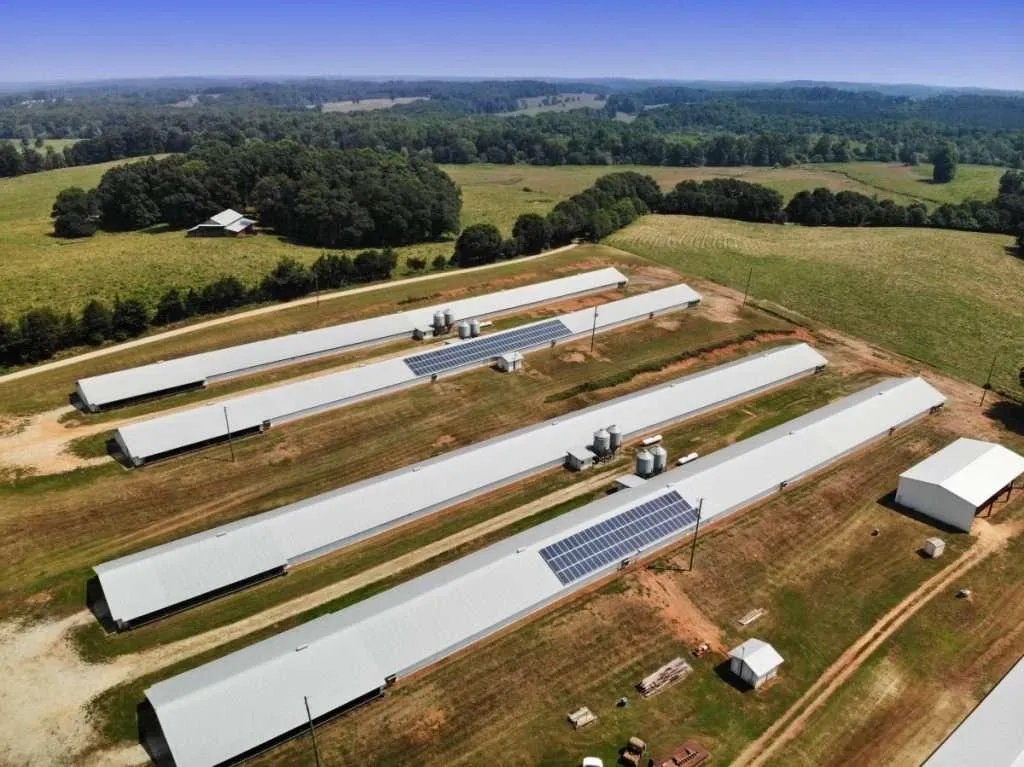
The Farm as a Power Plant - Part 5 of 5
American agriculture has always been about turning natural resources into productive assets. Electricity can be next.
A farmer looks at acreage differently than most people.
Where someone else sees dirt, a farmer sees yield.
Where someone sees a building, a farmer sees production capacity.
Where someone sees equipment, a farmer sees an asset that needs to produce enough value to justify its cost.
So here's another way to look at your farm:
It's has the potential to also be an energy producing asset.
For generations, American farms have purchased nearly all of their electricity from somebody else.
That made perfect sense when centralized generation was essentially the only practical model available.
Technology has changed that equation.
Today, a farm can simultaneously be: an agricultural operation AND an electricity producer.
Not because every farmer needs to become an energy company.
Because every business owner should examine whether one of their largest recurring operating expenses can be converted, at least partially, into something they produce themselves.
Remember the Normandy analogy?
In Part 1, we talked about the enormous new wave of electricity demand approaching America's grid.
Data centers.
AI.
Advanced manufacturing.
Electrification.
Industrial reshoring.
That wave hasn't disappeared.
According to experts, the U.S. peak electricity demand could reach 850–930 GW by 2030, compared with roughly 760 GW today, creating the possibility of an enormous generation-capacity challenge. The US is scrambling to meet surging power demand, and that is today. Tomorrow we are going to have a situation.
America is going to respond.
We'll build natural-gas generation.
We'll expand transmission.
We'll invest in nuclear.
We'll deploy batteries.
We'll modernize the grid.
The price of energy today will become a distant memory, just like when we could buy gas at $1.00 per gallon. We don't even know how good we have it...
And along with all of those other responses, the intelligent consumer is going to install an enormous amount of solar - the utility companies will too, of course, and then they will start charging us for the power it produces just like all of the other methods of electricity generation. It will just become one of the many.
This isn't an argument that one technology should power America.
It's an argument that farmers don't have to wait for everyone else to solve the problem for them.
The most important energy question for a farm is much smaller.
Not:
“How should America generate electricity to handle the growing demand in the future?”
But:
“What is the smartest, most cost-effective way to power this farm now, AND for the next 25 years?”
That's a question we can actually answer.
We can analyze historical electricity usage.
We can identify seasonal demand.
We can examine the utility's rate structure and net-metering rules.
We can model future utility costs.
We can even determine how much generation can realistically be produced on the property.
And then we can put two numbers beside each other:
1. The cost of doing something.
versus
2. The cost of doing nothing.
Because energy independence doesn't necessarily mean disconnecting from the grid.
For an American farmer, it can mean something much more practical:
Owning more of what your operation needs. Cutting down on overhead and operating costs. Producing your own power.
You already produce the food.
Maybe it's time to produce some of the power, too.
Power forward, with American AgriSolar
Your land. Your farm. Your power.
Stop renting it from someone else.